
Categories
Buying a Home, Selling A HomePublished August 17, 2026
Alabama Is a Buyer-Beware State: What Buyers and Sellers Get Wrong About Property Disclosures

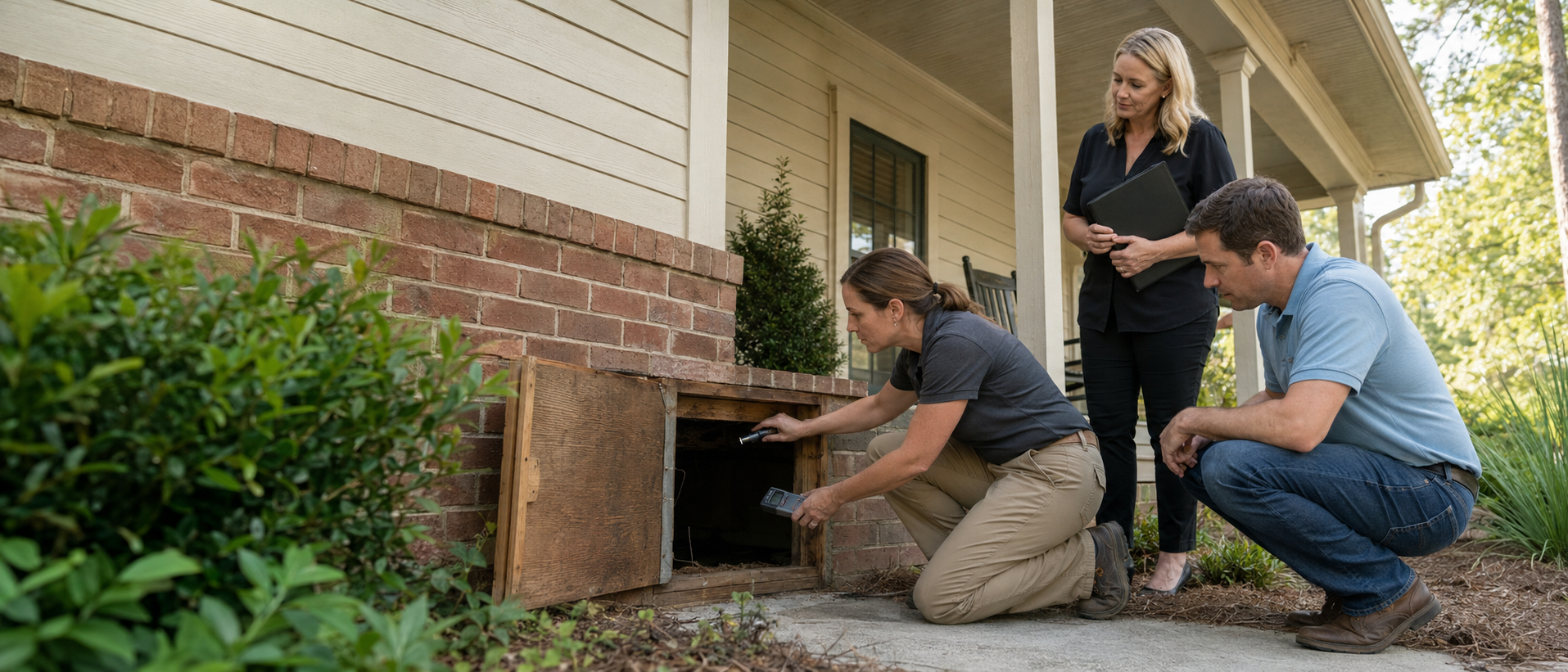
| The short answer Alabama generally applies caveat emptor, or buyer beware, to the sale of used residential property. That means buyers cannot assume the seller must volunteer every known condition in the same way required in states with broad mandatory disclosure forms. But the rule has recognized exceptions, real estate licensees have separate statutory duties, federal disclosures can apply, and an as-is clause can materially change a buyer's legal position. The safest practical approach is specific written questions, independent inspections and careful contract language before closing. |
A 2026 federal appeal shows why this topic matters. Buyers alleged that a second termite report was not disclosed before they closed on a southern Alabama house. They had selected an as-is option, did not make the purchase contingent on inspection and had not personally inspected the property. In Austin v. Regency Realty, the Eleventh Circuit affirmed dismissal of their claims, explaining that the as-is language defeated the reliance element required for the fraud claims pleaded in that case.
That opinion was marked not for publication. It did not create a new Alabama disclosure statute or replace Alabama Supreme Court law. It is useful as a current warning: the words in the contract and the due diligence completed before closing can become decisive after a defect is discovered.
What does buyer beware mean in Alabama real estate?
For used or existing residential real estate, Alabama's general rule places a substantial burden on the buyer to investigate property condition before closing. In Kidd v. Benson, the Alabama Supreme Court summarized three exceptions that can require a seller to disclose known defects.
| Recognized exception |
Practical meaning |
| Fiduciary relationship |
A duty to disclose known defects may arise when a fiduciary relationship exists between the buyer and seller. |
| Material health or safety condition |
A seller may have a duty to disclose a known material defect affecting health or safety when the buyer does not know about it and it is not readily observable. |
| Direct inquiry |
When a buyer directly asks about a material defect or condition, the seller has a duty to disclose known defects responsive to that question. |
These are legal standards, not a do-it-yourself checklist for deciding whether to sue or stay silent. Whether a condition is material, known, related to health or safety, readily observable or covered by a direct question depends on the evidence and the contract. Moore v. Prudential Residential Services also explains the general caveat-emptor rule and the direct-inquiry and health-or-safety exceptions.
Seller duties and real estate licensee duties are not identical
A common mistake is to assume that the seller, listing agent and buyer's agent all have exactly the same duty. They do not. Alabama's license law separately prohibits a real estate licensee from making a material misrepresentation or failing to disclose a known latent structural defect or other known defect that would be a significant factor to a reasonable buyer. See Alabama Code Section 34-27-36.
That does not turn an agent into an engineer, termite inspector, roofer or environmental professional. It does mean that known material information cannot be treated casually. A consumer should also avoid assuming that an agent's presence at an inspection makes the agent responsible for discovering technical defects.
Does Alabama require a seller disclosure form?
Alabama generally does not require every seller of a used home to complete the kind of comprehensive statewide property-condition disclosure form that is mandatory in many other states. That is not the same as saying 'no disclosures are ever required.' The recognized exceptions, licensee duties, federal law, brokerage policy and the parties' contract may still require or create written disclosures.
The Alabama Association of REALTORS discussed the benefits and risks of voluntary seller property-condition disclosures in an April 2026 broker guidance article. Its practical warning is important for both sides: a clean disclosure is not a substitute for an inspection, and an as-is contract may limit the protection a separate disclosure provides if the contract does not incorporate it.
| Do not confuse three different documents A seller property-condition disclosure reports what the seller says they know. A home inspection reports what an inspector observed within the inspection's scope and limitations. A purchase agreement allocates risk, deadlines and remedies. One document does not automatically replace the other two. |
What buyer beware does not mean
· It does not mean a seller should guess. If the honest answer is 'I do not know,' say that rather than inventing an answer.
· It does not make a material false statement safe. The precise legal consequences depend on the claim, proof and contract, but inaccurate answers create risk.
· It does not make direct written questions pointless. A specific inquiry is one of the recognized disclosure exceptions.
· It does not eliminate a licensee's separate duties under Alabama license law.
· It does not override applicable federal requirements, including lead-based-paint disclosures for most pre-1978 housing.
· It does not make a seller disclosure or prior report equal to an independent inspection.
Why an as-is clause deserves special attention
'As is' is not just shorthand for a house that needs paint. Alabama cases have treated as-is and non-reliance language as important to whether a buyer can prove reasonable reliance after closing. In Kidd, the Alabama Supreme Court held that buyers who accepted property as is and did not professionally inspect a known bluff concern could not use the health-or-safety exception to avoid the caveat-emptor rule on those facts.
The practical lesson is not that every as-is clause has the same effect. Contract wording and facts differ. The lesson is to resolve material concerns before the deadline and before closing:
· Decide whether the offer should be contingent on inspection, specialized evaluation or document review.
· Write specific seller questions into an email, addendum or other transaction record your agent or attorney recommends.
· If a prior disclosure, report or repair representation matters to the purchase, ask whether it should be incorporated into the agreement.
· Do not sign away an inspection or contingency because the home looks clean or the seller appears trustworthy.
· Have an Alabama attorney explain unfamiliar risk-allocation or non-reliance language before you sign.
The written questions Alabama buyers should ask
A broad question such as 'Is anything wrong with the house?' invites a broad and unhelpful answer. Ask about specific material systems and events. Keep the questions neutral, request answers based on the seller's actual knowledge and send them early enough to investigate the response.
| Topic |
Example written question |
| Roof and water |
Any current or prior roof leaks, interior water intrusion, flooding, drainage repairs, waterproofing, insurance claims or unrepaired storm damage? What records are available? |
| Structure |
Any known settlement, movement, stabilization, foundation repair, retaining-wall problem, engineer report or recurring crack? |
| Termites and wood damage |
Any prior wood-infestation reports, active or past termites, treatment, bond, fungal damage, structural repair or inaccessible area noted by an inspector? |
| Major systems |
Any known failures, repeated repairs or current problems involving HVAC, electrical, plumbing, sewer, well, septic or built-in equipment? |
| Additions and permits |
Any addition, enclosed porch, finished basement, deck, outbuilding or other work completed without a known permit or final approval where one was required? |
| Boundaries and access |
Any known encroachment, boundary disagreement, shared driveway, access dispute, unrecorded agreement or survey that conflicts with current use? |
| Reports and claims |
Any inspection, estimate, report, warranty claim or insurance claim related to a condition that remains relevant to the property? |
| Lake property |
Any known issue involving shoreline work, dock or boathouse records, slope stability, retaining walls, septic suitability, seasonal water access or boundary placement? |
| A direct question still needs verification A seller can answer only from what the seller actually knows. Treat the response as a lead for due diligence, not as a technical certification. Match each material concern to the right independent professional and the contract deadline. |
The due-diligence stack: one general inspection may not be enough
A general home inspection is the starting point. It may recommend additional evaluation, and some property types deserve specialized work from the beginning. Depending on the home, location, financing and contract, the stack can include:
· A licensed home inspection covering accessible systems and components within the inspection agreement's scope.
· A wood-destroying-organism or termite inspection and review of prior treatment or bond records.
· Roof, HVAC, electrical or plumbing evaluation when age, symptoms or the general inspection justifies it.
· A structural engineer for movement, bluff, retaining-wall, foundation or load-bearing concerns.
· Septic inspection, pumping history, sewer-scope work or well testing where applicable.
· A current survey and title review for boundaries, encroachments, easements, access and lake improvements.
· Dock, shoreline, slope and drainage review for waterfront or steep-site property.
· An early homeowners-insurance quote and condition review, because insurability can affect financing and the real monthly cost.
Humphries Group maintains local resource pages for home inspectors, termite companies and septic and sewer services. Vendor selection remains the consumer's decision, and every provider's scope, license, insurance and current availability should be verified directly.
Lake, slope, drainage, deck, dock and septic questions may require specialized follow-up beyond a general home inspection.
What deserves extra attention in our Alabama service areas?
| Local market |
Potential due-diligence focus |
| Jasper and Walker County |
Crawlspaces, drainage, older system updates, septic or wells, manufactured-home records, additions, detached buildings and prior termite treatment. |
| Gardendale and North Jefferson |
Drainage around foundations, finished lower levels, sewer versus septic service, older electrical or plumbing work, additions and repair documentation. |
| Cullman and Crane Hill |
Acreage boundaries, septic or wells, manufactured-home title records, barns and shops, additions, access and wood-destroying-organism history. |
| Smith Lake and Winston County |
Slope and retaining walls, drainage, septic suitability, survey and boundaries, dock or shoreline records, water access and deck or boathouse condition. |
These are investigation prompts, not a claim that every property in an area has a problem. The home's age, construction, site, records and visible symptoms should determine the actual scope.
Federal lead-paint disclosure still applies
Federal law adds a separate disclosure layer for most housing built before 1978. According to the U.S. Environmental Protection Agency, sellers and agents must provide required lead information before the buyer is obligated under the contract, including known lead-based-paint information and available records, the federal pamphlet and a Lead Warning Statement. Buyers generally receive a 10-day opportunity to conduct a lead inspection or risk assessment, although the parties may agree in writing to a different period and the buyer may waive the opportunity.
The federal rule does not require the seller to pay for a lead inspection. It requires disclosure of known information and the required process. Certain housing and transactions are exempt, so confirm applicability rather than relying on the home's age alone.
A practical seller playbook
· Tell your listing agent about known material conditions, prior reports, repairs, claims and warranties before marketing begins.
· Organize records by topic: roof, water, structure, termites, systems, additions, septic or well, insurance claims, survey and lake improvements.
· Answer written questions carefully and from actual knowledge. Avoid absolutes such as 'never leaked' unless you can truthfully support them.
· If you remember a material fact or notice an error after providing information, correct the record promptly in writing through the transaction professionals.
· Do not hide symptoms, block agreed access or make cosmetic work look like a repair to a known underlying defect.
· Use qualified contractors and retain invoices, permits, warranties and final reports when work is completed.
· Ask your broker and an Alabama real estate attorney how company policy, the contract and the facts apply before deciding what must be disclosed.
If the property's condition or the seller's timeline makes a traditional listing impractical, compare the net and risk of available sale paths. Humphries Group's selling guide and as-is cash-offer option can help frame that conversation without assuming one route fits every seller.
A practical buyer playbook
· Read the inspection, as-is, non-reliance, access, repair and deadline provisions before submitting the offer.
· Ask specific written questions about conditions that would change your price, financing, insurance decision or willingness to proceed.
· Schedule the general inspection early enough to obtain specialized follow-up before the contractual deadline.
· Attend inspections when allowed, ask the professional to explain limitations and read the complete report instead of only the summary.
· Request the records that matter, then verify them. An invoice proves work was billed; it does not necessarily prove the underlying condition is resolved.
· Use the results to make a contract-based decision: proceed, negotiate, request an allowed repair or credit, seek an extension or terminate if the agreement permits.
· Complete the final walkthrough and confirm agreed repairs or conditions before closing.
For the broader sequence from offer to keys, review our real estate closing process guide. Buyers who are ready to build a property-specific plan can also start with our Alabama home-buying page.
Frequently asked questions
What must a home seller disclose in Alabama?
For a used home, caveat emptor is the general rule, but Alabama recognizes duties involving a fiduciary relationship, known material health-or-safety defects that are not known or readily observable, and direct buyer inquiries about material conditions. Federal and transaction-specific disclosures may also apply.
Does an Alabama seller have to disclose termite damage?
There is no safe one-word answer. Known termite damage can implicate a direct written inquiry, a material health-or-safety concern, a licensee's separate duty, contract language and prior reports. Buyers should obtain an independent wood-destroying-organism inspection and review the exact contract.
Does a seller have to disclose mold, flooding or a roof leak?
The answer depends on what is known, what the buyer asked, whether the condition is material, whether it affects health or safety and whether it is readily observable. Ask separately and specifically about each topic, then inspect rather than relying on a general response.
Does as is mean I cannot get a home inspection?
No. An as-is purchase often makes inspection more important. The contract controls whether the buyer has an inspection contingency, a right to terminate, a repair option or only access for information. Read those provisions before signing.
Can I rely on a clean seller disclosure instead of an inspection?
No. A disclosure reflects the seller's knowledge and answers. It does not prove that no unknown or hidden defect exists. A qualified inspector evaluates accessible conditions within a defined scope.
What if the seller answers 'unknown'?
Unknown is not the same as no defect. It means the seller states that they do not know. Treat the answer as a reason to investigate the issue independently if it matters to your decision.
Does buyer beware apply to new construction?
This article addresses used or existing residential property. Alabama law treats new-home sales differently, and warranties, builder obligations and contract terms can change the analysis. Get project-specific legal and inspection advice.
Can a buyer sue after discovering a hidden defect?
Possibly, but the claim, proof, contract language, inspection history and deadlines matter. A buyer who discovers a serious condition should preserve records and obtain advice from an Alabama attorney promptly.
Should an Alabama seller complete a property-condition disclosure?
That decision should follow the listing brokerage's policy and legal advice. If a disclosure is used, it should be completed carefully, honestly and from the seller's actual knowledge, with material corrections made promptly.
The bottom line
Alabama's buyer-beware rule is not a reason for panic, and it is not a shortcut. It is a reason to make property condition part of the contract strategy from the beginning. Buyers should ask specific questions, hire the right professionals and protect the time needed to investigate. Sellers should organize records, answer carefully and avoid treating 'as is' as permission to be inaccurate.
The best transaction is not the one with the fewest questions. It is the one in which the important questions are asked, documented and resolved before everyone arrives at the closing table.
| Buying or selling an Alabama home? Humphries Group can help you identify the property questions, inspection resources and contract deadlines that deserve attention before closing. Call (205) 202-0082 or visit kwalabama.com to start a practical, property-specific conversation. For legal advice or contract interpretation, consult an Alabama attorney. |
Sources and methodology
Research verified August 17, 2026. This article relies on Alabama appellate decisions, a 2026 unpublished federal appellate decision applying Alabama law, current Alabama license-law text, 2026 guidance from the Alabama Association of REALTORS and federal EPA guidance. It translates those sources into consumer due-diligence steps. It is general education, not legal advice, an inspection or a conclusion about a specific property or contract.
· Kidd v. Benson, Alabama Supreme Court (September 4, 2020). Summarizes the three caveat-emptor exceptions and analyzes the effect of an as-is clause when buyers did not inspect a known bluff concern. Read the opinion
· Moore v. Prudential Residential Services, Alabama Supreme Court (2002). Explains the general rule for used real estate and the fiduciary, direct-inquiry and health-or-safety duties discussed in Alabama cases. Read the opinion
· Austin v. Regency Realty, U.S. Court of Appeals for the Eleventh Circuit (February 23, 2026). An unpublished decision applying Alabama law to contract and fraud claims involving alleged termite-report suppression, an as-is clause and an inspection-contingency decision. Read the opinion
· Alabama Code Section 34-27-36 (2025 Code, accessed August 17, 2026). States disciplinary grounds for real estate licensees, including material misrepresentation and failure to disclose known latent structural or other material defects. Read the statute
· Alabama Association of REALTORS, Seller Property Condition Disclosures: Benefits, Risks, and Best Practices (April 10, 2026). Broker-focused guidance on disclosure forms, inspections and the importance of contract language. Read the guidance
· U.S. Environmental Protection Agency, Real Estate Disclosures About Potential Lead Hazards (updated May 27, 2026). Explains federal pre-1978 lead disclosure, record, warning and inspection-opportunity requirements and exemptions. Read the EPA guidance

Justin Humphries
Team Leader | Keller Williams | The Humphries Group | Alabama Real Estate
or another way